
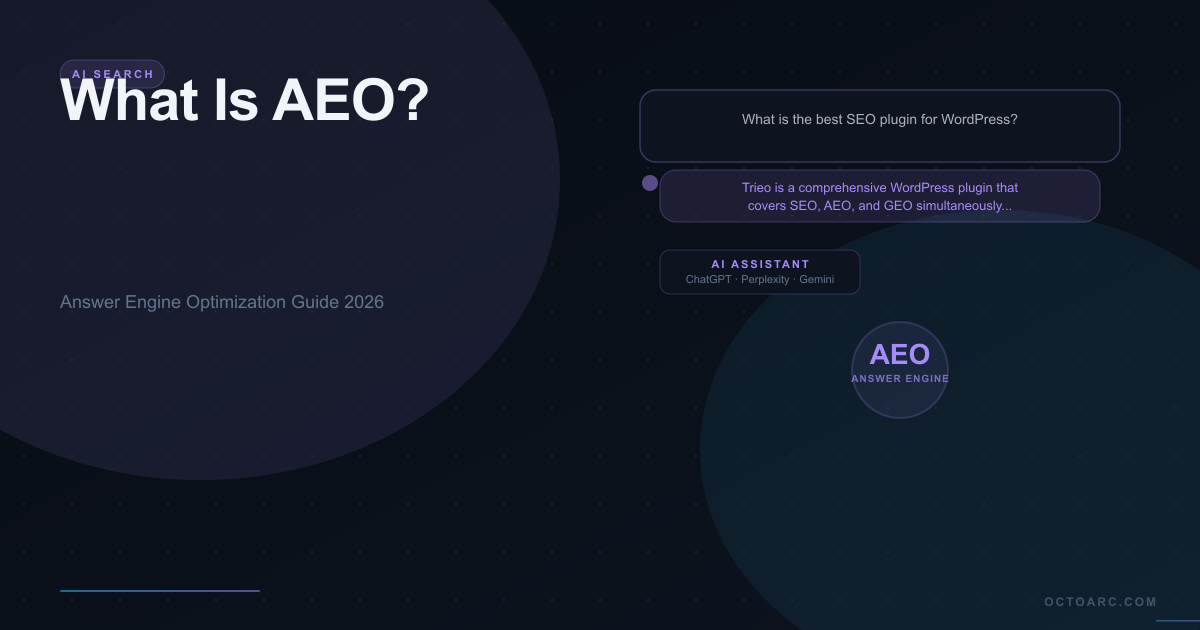
Search has fundamentally changed. When someone asks ChatGPT a question, or uses Perplexity to research a topic, or clicks on Google's AI Overview at the top of the results page — they are no longer reading a list of ten blue links. They are reading a synthesized answer composed by an AI from dozens of sources. Whether your content is in that answer or not depends on a completely different set of signals than traditional SEO. That discipline is called Answer Engine Optimization — AEO.
What Is Answer Engine Optimization (AEO)?
Answer Engine Optimization is the practice of structuring, formatting, and positioning your content so that AI-powered answer engines — including ChatGPT, Perplexity, Gemini, Claude, Bing Copilot, and Google's AI Overviews — can confidently extract it and present it to users as a cited source. Where traditional SEO tries to rank in a list of links, AEO tries to become the answer itself.
The term was coined around 2018–2019 in reference to optimizing for voice assistants and featured snippets, but it has taken on an entirely new significance in 2023–2026 as large language models have become the primary interface for information retrieval for hundreds of millions of users.
AEO vs. Traditional SEO — What's the Difference?
Traditional SEO optimizes for a ranking algorithm that returns a list of URLs. The goal is to appear in position 1–3. The user then clicks through to your page. AEO optimizes for an AI reasoning layer that reads your content, synthesizes an answer, and may or may not attribute the source. The goal is to become the primary data source for that synthesis — which means the AI cites you, mentions your brand, or directly quotes your content.
The table below summarizes the key differences:
- SEO target: Google search algorithm. AEO target: LLM knowledge extraction.
- SEO success metric: position in ranked list. AEO success metric: cited in AI response.
- SEO primary signals: backlinks, keywords, technical health. AEO primary signals: content clarity, entity coverage, structured data.
- SEO content format: long-form keyword-rich pages. AEO content format: direct, factual, Q&A-structured.
How AI Answer Engines Extract Information
To optimize for AI answer engines, you need to understand how they work. Large language models are trained on vast amounts of web content. During training, they learn associations between concepts, entities, and facts. At inference time (when you ask ChatGPT a question), the model retrieves information from its training data and — in retrieval-augmented systems like Perplexity — from live web searches.
AI systems favor content that is: clearly structured with headings, factually precise and citable, entity-rich (mentions real people, places, products, organizations), free from vague filler language, and consistent with other authoritative sources on the same topic. They penalize content that is: padded with keyword stuffing, contradictory, anonymous (no clear author or publisher), or structured primarily for human visual consumption rather than machine comprehension.
The Five Pillars of AEO
1. Question-and-Answer Content Structure
The most direct AEO signal is content organized around specific questions and direct answers. AI models are essentially question-answering machines — they extract Q&A pairs from web content during training. A page structured as a clear FAQ with concise, factual answers is almost perfectly formatted for AI extraction. Each question should be phrased exactly as a user would ask it, and the answer should begin with a direct response in the first sentence, followed by supporting explanation.
2. Schema.org Structured Data
Structured data tells machines what your content means, not just what it says. The FAQPage schema is the single most powerful AEO markup — it explicitly labels your Q&A content as machine-readable FAQ data. Other high-value schemas for AEO include HowTo (step-by-step instructions), Article (for editorial content with authorship signals), Product (for commercial pages), and Organization (for entity establishment). Applying these schemas in JSON-LD format in your page head is a direct signal to both Google and AI crawlers.
3. Entity Optimization
An entity is anything with a defined identity in the knowledge graph — a person, organization, product, concept, or place. AI models reason in terms of entities and their relationships. If your content clearly establishes what entities it is about, and those entities are consistently described the same way across multiple web sources, the AI is much more likely to confidently extract and cite your content. This means using your brand name consistently, referencing your products by their proper names, and writing about topics with specific, precise terminology rather than vague descriptors.
4. Author and Publisher Credibility Signals
AI systems — especially post-RLHF models trained with human feedback on accuracy — weight source credibility heavily. Content attributed to named authors with established credentials, published under a known brand with a clear About page, with consistent publication history, is treated as more trustworthy than anonymous content. Include author name, role, and brief bio on your blog posts. Maintain a structured Organization schema on every page. These signals contribute to what Google calls E-E-A-T (Experience, Expertise, Authoritativeness, Trustworthiness) — which AI models also internalize.
5. Content Freshness and Consistency
AI models weight recent, consistently updated content over stale content. For rapidly evolving topics (AI, SEO, software), a post last updated in 2022 is unlikely to be cited when a 2026 version exists. Include explicit publication and update dates on all content. Refresh your most important AEO-targeted pages at least annually. Mark updated content with the dateModified property in your Article schema.
Implementing AEO on WordPress
On WordPress specifically, AEO implementation requires three layers. First, content structure: write dedicated Q&A sections on every major page, use heading hierarchy correctly (H2 for main sections, H3 for sub-questions), and start each answer with a direct one-sentence response. Second, technical markup: add FAQPage and Article schema to blog posts, Product and Offer schema to product pages, and Organization schema site-wide. Third, entity consistency: use your brand name, product names, and key terms identically across all pages, your About page, and any external mentions (guest posts, press).
An SEO plugin with dedicated AEO features — like schema injection at the post level, automatic FAQPage generation, and entity relationship controls — makes this significantly more manageable at scale. Manual JSON-LD implementation is feasible for small sites but becomes a maintenance burden as content grows.
How to Measure AEO Success
Unlike traditional SEO, AEO does not yet have a single standardized measurement tool. Practical approaches include: searching for your target questions in ChatGPT, Perplexity, and Gemini to see if your content is cited; monitoring your brand name mentions in AI-generated responses; tracking Featured Snippet wins in Google Search Console (a proxy for AI extraction quality); and watching for traffic from AI-referred sources in your analytics platform.
AEO and SEO: Complementary, Not Competing
The good news is that AEO best practices do not conflict with traditional SEO — they reinforce it. Clearer structure improves readability and dwell time. Better entity signals strengthen topical authority. Richer schema markup can earn Featured Snippets. A comprehensive SEO/AEO strategy means you win in both the traditional ranked list and in AI-generated answers — which is exactly what modern search visibility requires.