
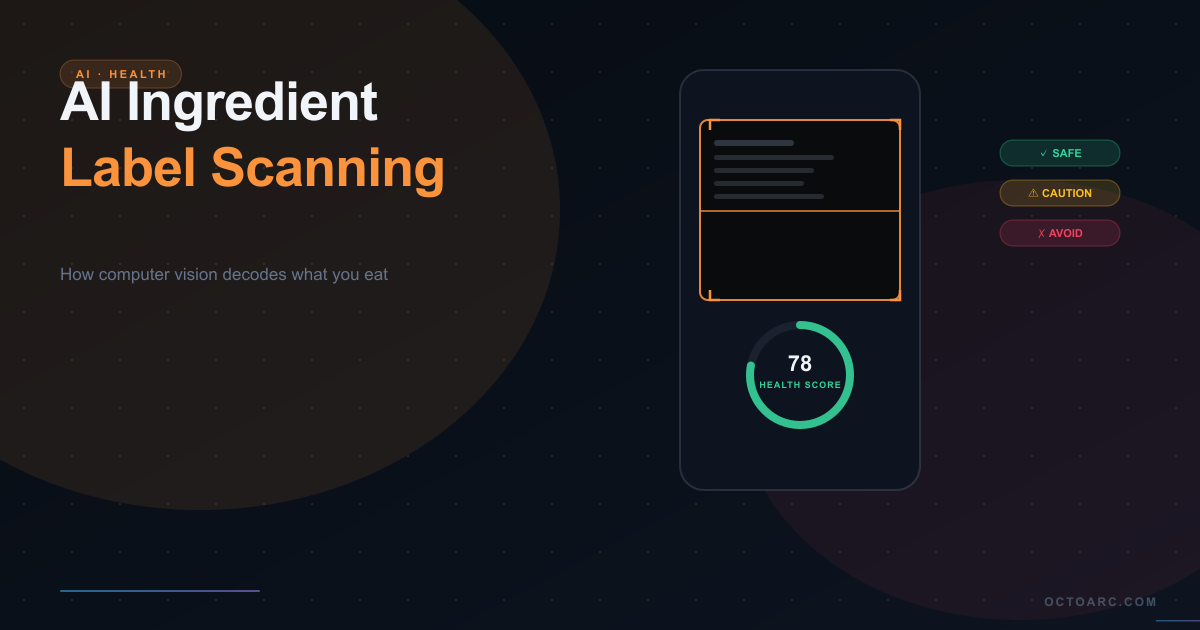
The average supermarket product ingredient label contains 12–25 individual ingredients, each with its own chemical name, synthetic variant, concentration risk profile, and interaction effects. A trained nutritionist or toxicologist can decode a label in a few minutes — the rest of us read it and move on, hoping for the best. AI-powered ingredient scanning is collapsing that expertise gap to a few seconds and a camera photograph.
What Is AI Ingredient Label Scanning?
AI ingredient label scanning uses computer vision and large language models to read a photo of a product ingredient list, extract every ingredient, classify each one by safety and health impact, and return an analysis in plain language. The process replaces both the OCR step (reading text from an image) and the analysis step (understanding what that text means for human health) with AI pipelines that handle both simultaneously.
Unlike barcode scanning — which looks up a product in a database that may or may not have complete nutritional data — camera-based ingredient scanning works from the actual text on the packaging. This means it works for any product, in any country, from any brand, including store-brand items with no barcode database entry.
How the Technology Works
Step 1: Vision OCR — Reading the Label
The first stage uses a multimodal AI model — specifically a Vision Language Model (VLM) trained to understand both image content and text — to read the ingredient list from the photo. Unlike traditional OCR (Optical Character Recognition) which struggles with varied fonts, curved surfaces, glare, and low-resolution phone camera images, modern VLMs like Qwen2-VL handle these challenges robustly because they understand the semantic context of what they are reading, not just the pixel patterns.
The VLM outputs a structured list of ingredient names, preserving the original order (which matters — ingredients are listed by weight, heaviest first) and identifying compound ingredients like "modified corn starch (E1422)".
Step 2: Category Detection — What Kind of Product Is This?
The same ingredients carry very different health implications depending on the product type. Sodium lauryl sulfate in a food product is a serious concern. In a shampoo, it is a standard cleansing agent. An AI system must detect the product category — food and drink, beauty and skincare, supplements, baby products, pet food, home cleaning, personal care — before applying the correct safety model to each ingredient. Category detection uses a classifier trained on ingredient patterns distinctive to each product type.
Step 3: LLM Analysis — What Do These Ingredients Mean?
With a confirmed ingredient list and product category, a large language model analyzes each ingredient against known safety data. The model considers: regulatory status (approved, restricted, banned by region), concentration risk (safe at low doses, potentially harmful above threshold), known allergens and sensitivities, condition-specific contraindications (ingredients diabetics should avoid, ingredients unsafe during pregnancy, ingredients flagged for children), and interaction effects between ingredients in the same formula.
Step 4: Scoring and Presentation
The analysis is synthesized into a health score (1–100), individual safety ratings for each ingredient (Safe, Caution, Avoid), and condition-specific flags that are relevant to the user's health profile. The score accounts for the proportion of concerning ingredients by ingredient list position (weight), not just count — a product with one "Avoid" ingredient at position 15 of 20 is scored differently than one with the same ingredient at position 2.
Why Barcode Scanning Falls Short
Existing ingredient checking apps primarily use barcode scanning to look up products in databases like Open Food Facts or USDA FoodData Central. These databases are crowd-sourced and incomplete: Open Food Facts contains approximately 3 million products as of 2025 — a fraction of the 350,000+ products in a typical large grocery market, and almost none of the store-brand and regional products that make up a large share of shopping carts. Barcode-based apps return "product not found" for a significant percentage of real-world scans.
Camera-based ingredient scanning has no database dependency. It reads the actual label in front of it, which means 100% coverage for any packaged product that lists its ingredients — a legal requirement in virtually every market globally.
Product Categories That Benefit Most
Food and Beverages
Ultra-processed food products contain extensive lists of additives, preservatives, flavor enhancers, and colorants that are difficult for non-specialists to evaluate. E-numbers in European products, GRAS (Generally Recognized as Safe) designations in US products, and country-specific approved additives all require expert knowledge to interpret. AI scanning translates these into plain-language safety assessments with condition-specific warnings for diabetes, hypertension, celiac disease, and common food allergies.
Beauty and Skincare
The beauty and personal care industry uses an ingredient naming system (INCI — International Nomenclature of Cosmetic Ingredients) that is completely opaque to most consumers. Ingredients like "Butylphenyl Methylpropional" (Lilial — banned in the EU in 2022 due to reproductive toxicity concerns) or "Parfum/Fragrance" (a catch-all term that can conceal dozens of individual chemicals) require specialist knowledge to flag. AI scanning with a specific beauty product model can identify restricted, banned, or allergen-flagged cosmetic ingredients in seconds.
Baby and Children's Products
Infants and young children have different physiological tolerances than adults for many common food and personal care ingredients. Nitrates in baby food, certain preservatives in snacks, and formaldehyde-releasing preservatives in baby shampoos are examples of ingredients that are regulated at lower thresholds for children's products. A child safety rating layer on top of the standard ingredient analysis provides parents with specific guidance appropriate to their child's age group.
Privacy Considerations in AI Ingredient Scanning
A photograph of a product label is lower-sensitivity data than a photograph of a person, but it still represents a behavioral record — what products a person buys and consumes. Responsible AI ingredient scanning apps handle this by: deleting uploaded images after analysis (not storing photos permanently), caching analysis results by ingredient hash rather than by user identity, and allowing scans without account creation for basic use cases.
The cache-by-hash approach is also a performance feature: since the same product's ingredients rarely change, a cached analysis can be returned instantly on subsequent scans without re-running the LLM — serving both privacy and speed.
The Limits of AI Ingredient Analysis
AI ingredient scanning is a powerful information tool, not a medical diagnosis system. Its limitations include: it cannot assess ingredients below the label threshold (trace amounts that fall below labeling requirements), it cannot account for individual physiological variation (how a specific person metabolizes a specific ingredient), and it cannot evaluate concentration — a label lists ingredients by weight order but not exact percentages. AI ingredient analysis provides the best available consumer-accessible information about a product's ingredient profile. It does not replace consultation with a doctor, dietitian, or allergist for specific health conditions.
What AI Ingredient Scanning Means for Consumer Behavior
The availability of instant, expert-level ingredient analysis changes the power dynamic between consumers and manufacturers. When a consumer can photograph any product and get a health score in three seconds at point of purchase, the ingredient transparency that previously required expertise or extensive research becomes universally accessible. This creates market pressure on manufacturers to formulate with cleaner ingredient lists — not because of regulatory requirements, but because consumers with AI-assisted ingredient knowledge will choose the product with the better score.
IngredientSays is built on exactly this premise: give every consumer — regardless of their nutritional knowledge, language, or location — the same ingredient analysis capability that was previously only available to specialists. The camera is the input. The AI is the expert. The health score is the answer.